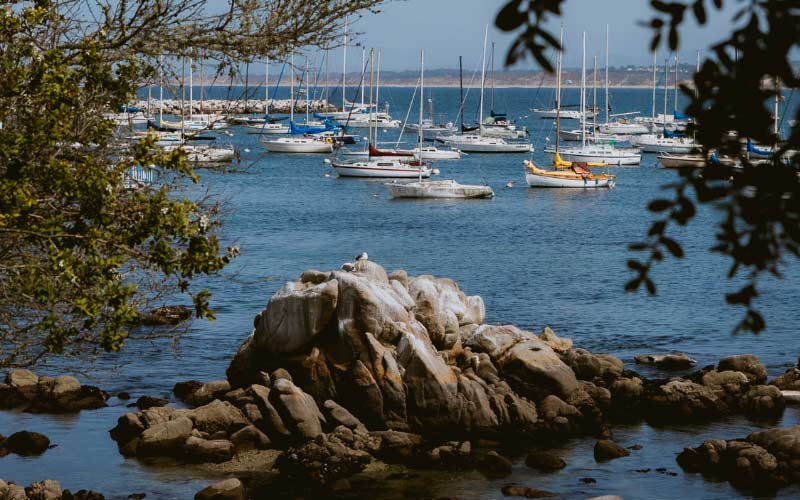
View of the bay in Monterey, California. Photo: Danielle Dong
A sustainability rating changed from yellow to red. This update triggered a lawsuit.
California’s Monterey Bay Aquarium helps consumers make informed seafood selections with their Seafood Watch program. Seafood Watch ranks the sustainability of seafood available in the United States as Best Choice (green), Good Alternative (yellow), or Avoid (red). In 2022, the aquarium changed its rating for lobster from yellow to red, primarily due to the harmful impacts that lobster fishing gear can have on the critically endangered North Atlantic right whale. A small group from the Maine lobster industry filed a defamation lawsuit against the Monterey Bay Aquarium Foundation for downgrading the fishery’s rating. At first glance, this may look like a dispute just between fishermen and an aquarium, but the risks extend far beyond the courtroom.
CLF has filed an amicus brief supporting the aquarium, recognizing what’s truly at stake. “Advocates cannot find solutions to the environmental problems we are facing if we cannot freely speak about the causes,” warns Sarah Shahabi, CLF associate attorney. “If the court sides with these five plaintiffs, it could chill speech for everyone, sending the message that when powerful parties don’t like what you have to say, they can use their resources to silence you.”
I am one of many who look to the Monterey Bay Aquarium as a trusted voice in marine research and conservation. Monterey’s magic left its mark on me long before I could walk. A frequent day trip for my family, my childhood was full of wildlife at every turn, guided by an aquarium that prioritized educating its visitors. Its approach instills a genuine respect and wonder for the marine life that thrives right outside its doors, and it’s precisely that wonder the Aquarium has always sought to protect.
Now, that voice is under threat. The outcome of this case will determine whether defamation claims can be weaponized by powerful industries to stifle legitimate environmental concerns and establish a precedent that determines the cost of speaking inconvenient truths.
A Path Forward
Seafood Watch identified 14 fisheries as of high concern because the heavy trap/pot and gillnet gear they use are connected to surface buoys by vertical lines that cause right whale entanglements and are one of the leading causes of death for the species. Just last month, a four-year-old whale was found dead from entanglement injuries. With fewer than 400 of these whales left worldwide, every loss is devastating.
We shouldn’t have to avoid eating lobster forever over this issue, because there’s a solution on the horizon. On-demand gear removes the dangerous vertical lines from the equation – instead of using buoys attached to heavy gear on the bottom, lobstermen can call this gear to the surface with an acoustic signal. CLF supports the creation of a new Seafood Watch rating for fisheries that utilize on-demand gear, recognizing those leading the way toward safer fishing. And CLF supports funding this transition to safer gear where and when it is necessary.

An Attack on Advocates Everywhere
Seafood Watch wasn’t created with malicious intent. It was established to provide science-based recommendations to help people make more sustainable decisions. I enjoy a lobster roll as much as the next person, but when hard data demonstrates that changes are needed, that information deserves to be heard. The aquarium simply presented what years of research have demonstrated: Fisheries that use gear with vertical lines pose a real, documented threat to the endangered North Atlantic right whale.
Certain members of the lobster fishery want the Aquarium defunded, advocating for the “Red Listing Monterey Bay Aquarium Act” in Congress to halt federal funding from reaching the institution. Lobster is not the only seafood on the red list. Other species such as Canadian snow crab carry the same rating based on the same rigorous science. If leading scientists and institutions can’t share research-based findings without facing legal threats, what does this mean for smaller voices who lack the resources to defend themselves?
Upholding free speech protections is essential for environmental progress. Silencing these conversations through defamation lawsuits threatens our collective ability to address environmental crises. If this lawsuit succeeds, it will send a stark warning to advocates everywhere, big or small: don’t speak up. You won’t survive the fallout.
Trust The Science
Protecting the North Atlantic right whale and other at-risk species requires collaboration, innovation, and the freedom to discuss risks and solutions transparently. If this lawsuit succeeds, the implications extend far beyond Monterey. Nonprofits, researchers, and individual advocates could be intimidated into silence whenever their findings challenge business interests, no matter how solid the science.
Thanks to Monterey, I grew up with a strong love and appreciation for the ocean and its inhabitants. It’s a connection I’ve carried with me ever since, shaped by an institution sitting within a national marine sanctuary that protects one of the most biodiverse ecosystems in the country. Walking around this coastal city, you’re guaranteed to hear the soft calls of gulls and the echoing barks of sea lions offshore, spot otters swimming atop fronds of giant kelp forests and seals napping atop granite spires, and even glimpse jellyfish drifting at the water’s surface.
The Monterey Bay Aquarium is a jewel that has been a leading force in marine research for decades, and if its funding is stripped as punishment for sharing scientific data, the impact on environmental education would be profound. And if an institution of their stature can be silenced, voices with less power stand little chance.
We now live in a world where public scientific data is being dismissed or completely erased, where federal leaders claim that rigorous research is illegitimate and unworthy of trust. We cannot let this become the norm. Free speech and scientific integrity have never been more critical to preserve. Cases like this are a benchmark for what we stand to lose, and what we must fight to protect.