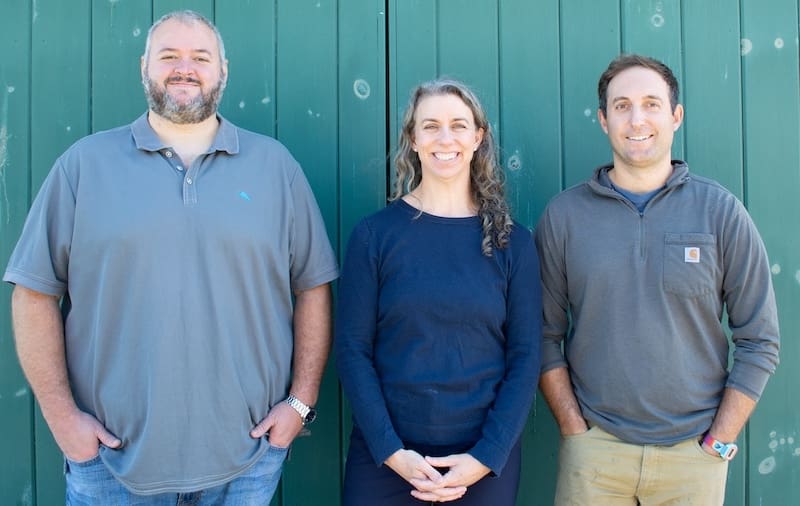
Dig Energy leadership includes Vice President of Engineering Dan Jepeal, CEO Dulcie Madden, and CTO Thomas Lipoma. Photo: Courtesy Dig Energy
Geothermal energy is having more than just a moment. More governments, towns, cities, and institutions embrace are embracing the wisdom of tapping the earth for reliable, inexpensive, and carbon-free heating and cooling. Even the Trump administration has shown interest in the benefits of geothermal energy.
But there’s always been one problem: Drilling the boreholes required in any geothermal project is expensive. The average cost of installing geothermal systems in a single-family home in the Northeast can stretch from $30,000 to $50,000 or more. About 50% of the cost of a ground-source residential heat pump comes just from installing the underground piping.
And when companies undertake larger commercial projects or districts, the costs can soar into the millions. One reason it’s so costly is that the drills used to bore these holes are massive and expensive to transport.
That’s where New Hampshire-based startup Dig Energy sees an opportunity. The brainchild of Thomas Lipoma and Dulcie Madden, Dig Energy is testing a water-jet drilling rig. It hopes to make drilling for geothermal energy so inexpensive that this carbon-free energy source may one day become more common in homes and businesses than fossil-fuel boilers and furnaces. According to Dig Energy CEO Madden, the water-jet drill may lower the cost of shallow drilling by as much as 80%.
“Our mission is simple: unlock the heat beneath our feet, an abundant, always-on resource, and give building owners a reliable, cost-competitive, and on-site way to heat and cool their buildings,” says Madden.
Boring Down into What’s Needed
The need for such technology could not be more evident. Heating and cooling buildings account for approximately one-third of the nation’s total energy use. And with data centers now in the mix, that figure is set to ratchet up higher. Geothermal can cut energy use dramatically, saving up to $4 billion annually.
According to the Oak Ridge National Laboratory, geothermal heat pumps deployed in both commercial and residential buildings, when coupled with building envelope improvements in single-family homes, can slash the carbon emissions equivalent to 1.5 billion cars through 2050. Using this technology could help shore up our aging electrical grid by reducing the system’s generation and capacity needs by up to 13% by 2050.
During heat waves in hot climate zones, electrical demand could be reduced by up to 28%. This is something that Madden is especially cognizant of, having spent five years living and working in India, where soaring temperatures often overpowered the electrical grid.
This fall, Dig Energy announced $5 million in seed funding to develop a proof-of-concept drilling rig. Several venture capital firms are supporting the effort, including Azolla Ventures, Avila VC, Conifer Infrastructure Partners, Mercator Partners, Koa Labs, and pre-seed investors Baukunst and Drew Scott. Dig Energy has also received support from Suffolk Technologies’ BOOST Accelerator and the U.S. Department of Energy’s American-Made Program’s EPIC Prize.
“This is a huge moment for our team and is the result of years of building, testing, and learning,” says Madden. “Now, the most exciting part begins: Taking our technology from the field into real-world installations and showing what’s possible when geothermal becomes simple, scalable, and cost-competitive.”
Perfecting Water-jet Drilling
Madden and Lipoma began exploring the idea of geothermal drilling about five years ago, following a stint with another Boston-based hardware startup. She has a background in business and public health; he is a mechanical engineer. The husband-wife team cast about seeking their next big idea and stumbled upon research describing how water-jets could be used to bore into the earth instead of high-cost carbide drill bits. Their interest was piqued.
“We wanted a sector we were deeply mission-aligned with and passionate about, and a tremendously large market to tackle,” explains Madden. “You really want a mission your entire team can align around where it’s something that compels you to go to work every day.”
The next few years were spent refining designs, conducting drilling tests near Dig’s offices in Manchester, New Hampshire, and closely observing how their water-jet drill performed in different conditions, including in soil, gravel, clay, sand, limestone, and granite. After hundreds of tests, Dig Energy is convinced its compact, purpose-built water-jet drill is up to the task of burrowing a few hundred feet beneath the earth’s surface.
“We’re at the stage where we’re doing a lot of field testing effectively every week,” says Madden of the company that consists of eight employees. “We have a team of engineers who go out and drill all the time and then work on the rig to make improvements and then drill again. We’re just marching our way through what we think we can take to market.”
Drilling into the Future
Dig continues its field testing in New Hampshire. It hopes to begin pilots next year. Eventually, Dig Energy plans to work across the construction industry to bring efficient heating and cooling to a wide range of buildings and geographies.
If Dig is successful in reducing the cost of geothermal drilling, this form of energy is likely to explode in popularity, far beyond the 1% of building installations that geothermal currently represents. That’s because operating geothermal systems is cheap once the upfront costs have been covered.
“The way we think about it is the grid is not built right now for all the demand that’s coming onto it, whether it’s AI or if you’re thinking about electrifying heating and cooling,” says Madden. “And so, we’re starting in New England, where between 40% and 65% of buildings still use heating oil and propane or natural gas, but heating oil is still a predominant fuel source. Those costs are increasing, which is, I think, why this is becoming increasingly compelling.”
And one of the best things about the technology, says Madden, is that it is not something that will take decades to perfect. It is a near-term solution to both the climate crisis and escalating energy costs.
“This is something that can really start to push the needle like this decade,” she says.