
This is the first in an occasional series examining how warmer winters are affecting New England
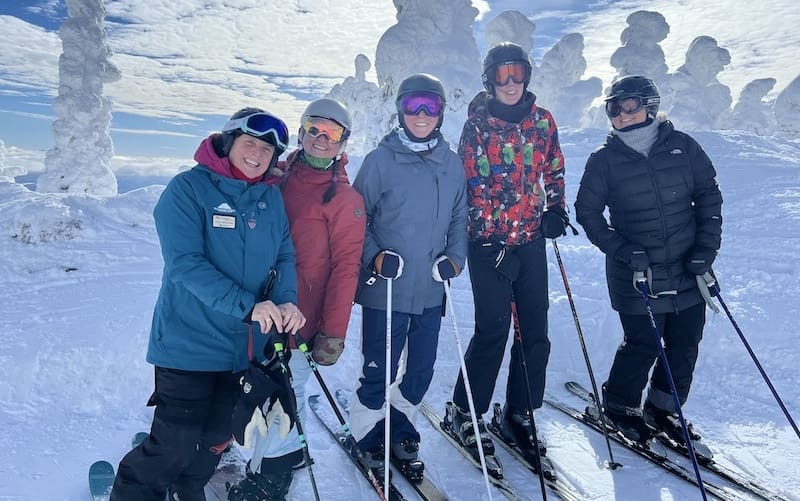
In the 20 years that Julie Silverman has been teaching skiing at Vermont’s Smuggler’s Notch Resort, a lot has changed. Decades ago, her students learned to ski in abundant quantities of classic Northeastern hardpack snow. These days, slick slopes – iced over by a never-ending cycle of snow, rain, and then cold – often border on the outright treacherous. Changing weather patterns, the result of climate change, have caused Silverman, who is also CLF’s Lake Champlain Senior Lakekeeper, to adjust the way she teaches.
“Guide the slide,” is her mantra. She teaches her students to lower their stance, avoid sudden moves, and make turns slowly, as they might when driving a car over a patch of slippery ice.
“We have always had icier slopes in the East than skiing out West,” observes Silverman. “But I could have people skiing on a Wednesday, and it could be, oh, I don’t know, 35 degrees and raining. And then two days later, on a Saturday, it’s freezing —like 20 or colder — and a sheet of ice, because it’s all frozen up. And teaching people in those conditions, some people are like, I’m not going out.”
In fact, she says, students often drop lessons in favor of something decidedly less risky.
Welcome to today’s winter in New England. Although the winter of 2025-2026 has been colder and snowier than the region has seen in many years, the trend is clear: winters are warming. The warmer winters Silverman has experienced on the ski slopes have affected, in recent years, all types of New England winter sports. In 2024, organizers in Vermont canceled the Lake Champlain Pond Hockey Classic due to melting ice. Ice fishers in New Hampshire have described ice fishing conditions as “almost surreal” – and not in a good way. And ski resorts throughout the region have resorted to making snow when Mother Nature isn’t providing.
Today, in the era of climate change, the winter sports once integral to New England’s identity are skating, literally, on thin ice. Gone is the certainty that on any given weekend in January, conditions will be cold and snowy enough for beloved sports like snowboarding, skiing, ice skating, or sledding.
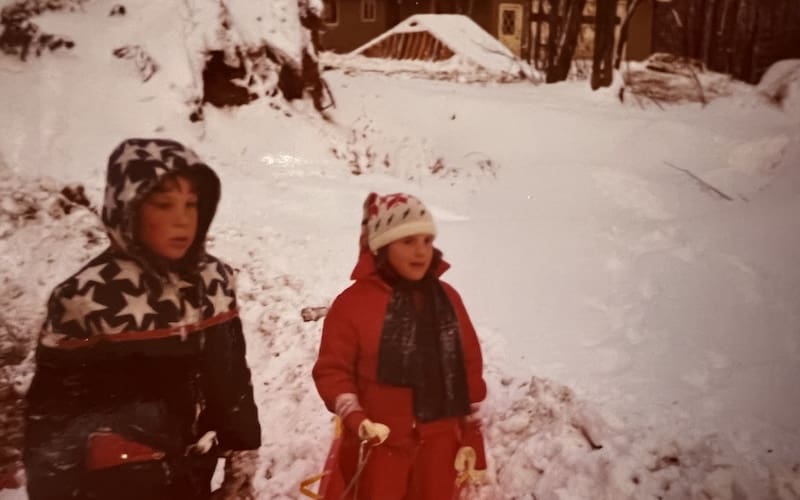
“I grew up here in Vermont,” reflects Silverman. “We would go outside, and the snow piles would be six feet high. The plow would come by, we would be playing in the snow, we would dig tunnels, we pretended like we were in some war and dug a long network of tunnels all around our driveway and around the snowbanks.”
Those were different days. Back then, it began snowing around Thanksgiving, and it continued to snow regularly through April.
Now, she says, “in the last 10 years, there’s been a really strange oscillation of rain and snow and rain and snow and rain and snow. It makes for a slippery mess.”
New England Winters are Warming the Fastest
Scientists confirm what Silverman has observed anecdotally. Elizabeth Burakowski, a research assistant professor of earth sciences at the University of New Hampshire, confirmed in a 2024 interview with SciLine that New England is experiencing some of the fastest winter warming in the world, with temperatures in Burlington, Vermont, and Concord, New Hampshire, standing out. She described New England and the Upper Midwest as “winter warming hotspots.”
In fact, climatologists say, because of climate change, winter in New England is becoming more like winter in New Jersey. This shift is a blow to the region’s economy, traditions, and indeed, its recreational spirit. After all, if we now experience a winter more characteristic of New Jersey, what makes us different from New Jersey?
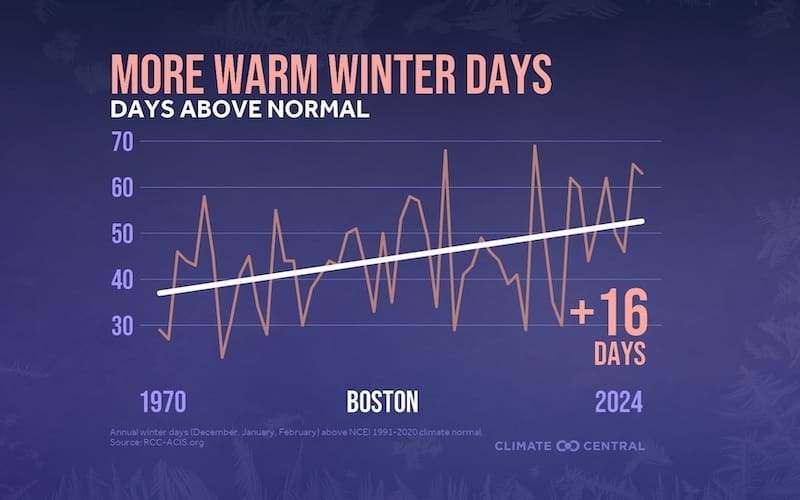
- New England winters are, on average, 3 degrees warmer than they were in the 1960s.
- In 2024, New England experienced its warmest winter on record since the late 1800s, with average winter temperatures failing to drop below freezing.
- Now, between November and March, a day in the 60s is not unheard of, as happened on February 16, 2023, when temperatures hit 62°F in Boston.
- Since 1953, New England has lost 16 hard freeze days each year.
Everything’s become topsy-turvy. Warmer temperatures result in more rain that freezes over when temperatures drop. But warmer temperatures also create unstable conditions for pastimes that depend on solid ice. Ice climbers, hockey players, ice skaters, or ice fishers looking for a slick, stable surface to drill through to set their lines are finding they can’t do their sport as often and must be more careful when they do. It’s a blow to sports enthusiasts, and it’s also a blow to businesses that count on cold temperatures and snow for income.
“I wouldn’t go so far as to say that businesses are ‘suffering,’ but they are definitely experiencing challenges with the changing climate,” says Jessyca Keeler, president at Ski New Hampshire. “That said, our industry has been fortunate that snowmaking and grooming technology has managed to keep up, which has allowed more snow to be made with less energy and resources in a shorter amount of time, and during shorter windows of opportunity.”
Reconciling the Economic Hit of Warmer Winters
While manufactured snow can help resorts struggling to provide patrons with a skiing experience that mimics natural snowfall, other sports have had to adapt in different ways. Ice fishing derbies, for example, are being moved to smaller lakes where ice is more likely to stay thicker and solid. Some ski resorts are leaning on summer activities like hiking and cycling to soften the financial blow of fewer skiing days. But even as resorts and other winter sports purveyors get creative, there is no denying the economic hit to a region losing its winter traditions.
Studies estimate that between 2001 and 2020, shortened ski seasons and unreliable snow have cost the U.S. ski industry $5 billion in lost revenue, or $250 million annually.
Snow-making machines have done a great job of filling in the gap in the increasingly snowless years, but, said Burakowski on SciLine, “ultimately, physics wins.”
“You have days when you can make snow at any temperature you want, but it’s going to melt at 32 degrees Fahrenheit. And when we see daytime temperatures getting well above 32, that means that even machine-made snowpack is going to start to melt, and that’s going to put some limits on how many skiers can safely recreate on the trails.”
The Broader Toll of Warmer Winters
Of course, there’s much more on the line here than the lost joy of not being able to ski or snowboard or even the economic fallout that potentially losing sports tourism will have on local towns and governments. Shorter snow seasons and warmer temperatures affect wildlife, forests, and the health of people and animals, who are exposed to illnesses caused by longer tick and mosquito seasons. When it doesn’t snow during the cold season, it often rains, leading to more frequent flooding events. For example, in December 2024, flooding hit Ludlow, Wilmington, and Montpelier, Vermont.
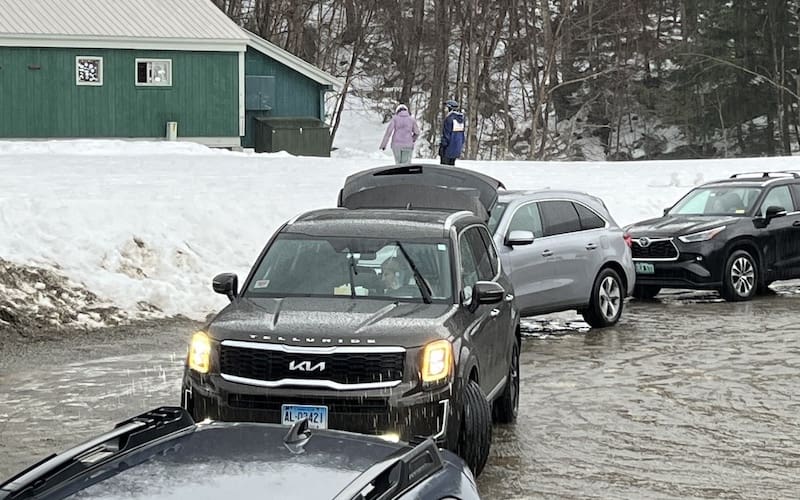
“Those rain-on-snow events are horrific,” says Silverman. “There’s no place for the water to go. The ground is frozen, and torrential rain floods right into our rivers and streams. This freeze-thaw cycle means the ruts on our dirt roads form and then freeze all winter, which is also horrible for the erosion that occurs on these roads. The water quality is impacted dramatically by all that dirt and pollution from cars and trucks washing into our rivers and streams.”
A Sense of Nostalgia for Lost Winters
For many New Englanders, there is a real sense of loss as local traditions and community life that once flourished in the snow and cold increasingly fall by the wayside. That leaves many New Englanders feeling bereft.
“My feeling is mostly one of frustration that we, as a society, as a nation, have the tools and technology to reduce greenhouse gas emissions and actually impact the rate of climate change, but we’re not doing it,” says Keeler. “That so much progress has been halted is disheartening. Skiing is New Hampshire’s official state sport – and it’s part of our culture. Having snowy winters is something New Englanders from my generation grew up with…I fear that current and future generations of New Englanders won’t get to enjoy the kinds of winters that I did.”
Burakowski concurs.
“When I experienced winter warming in my own environment, my own hometown, in my backyard, it’s a personal level of change,” she told SciLine. “And part of that includes feeling a sense of loss. And I embrace that sense of loss. I acknowledge it. I recognize that it’s happening… it’s important to acknowledge that and recognize that this is a real sort of feeling that you can have. But it’s also important to turn that apathy into action.”
The Future of Winter
Though warming winters are changing our environment and customs in inalterable ways, we do have a solution at hand to slow these changes. For one, we must reduce carbon emissions from sectors like transportation and buildings, which are the largest sources of climate-damaging emissions in New England. But Silverman stresses that we must also push legislators to enact new laws aimed at adaptation and resilience.
“I think the ski resorts, everybody, just has to keep adapting to what’s in front of us,” she says. “But we do have to do something. It’s only going to get worse if we don’t do anything about it.”
CLF is working on exactly that. We’re tackling the root causes of climate change by passing climate laws in five out of six New England states that limit the amount of carbon pollution we put into the air. At the same time, we’re pushing forward the transition from fossil fuels to clean energy sources like wind and solar power. We’re also making sure our communities are prepared for the climate change impacts already with us. That includes planning buildings, roads, and bridges to withstand increased flooding, planting more green spaces and trees to soak up water after floods, protecting our wetlands, which also soak up water after heavy rain, and passing laws like Vermont’s Climate Superfund Act, which makes fossil fuel polluters help pay for damage wrought by extreme weather.
You can do your part by standing with us and letting your legislators know that it is time for New England to prepare for climate impacts. Although today’s winter may be warmer than in years past, there’s no reason that tomorrow’s has to be.