
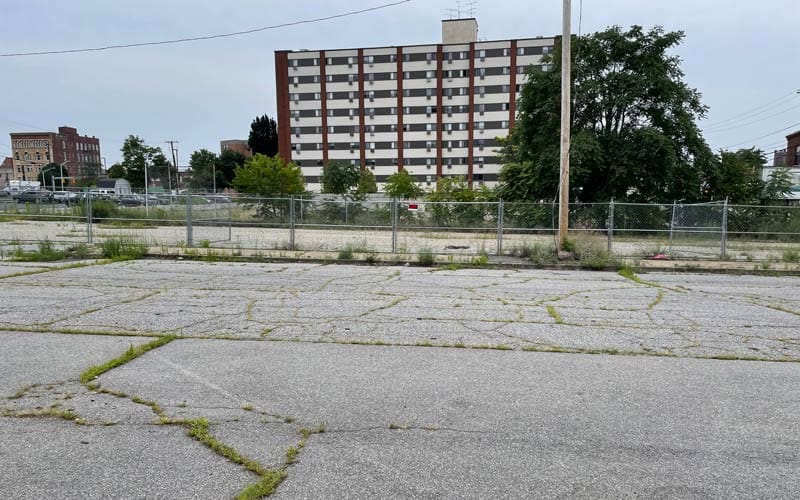
On a cold, drizzly morning, a crowd of people gathered in Pawtucket, Rhode Island. They stood before an old parking lot with cracking asphalt, framed by a chain link fence. But that’s not what they were seeing. Instead, they saw apartments, a market, a café. They saw Dexter Street Commons, a new housing and commercial development, breaking ground in a neighborhood in the midst of a revival. Despite the rain, the onlookers cheered when the shovels hit the dirt.
“What you’re seeing today is poised to transform the lives of future residents and the whole neighborhood,” says Darrèll Brown, CLF Vice President for Rhode Island, about the new development. “Dexter Commons sets the example and leads the way.”
What is Dexter Street Commons?
The Dexter Street Commons development will include 150 apartments. It is designed to be affordable for a range of income levels, pleasant to live in, and good for the climate and the environment. The development is part of a wave of investment in the Pawtucket community, including new riverwalks, a stadium, and a growing school district. The apartments will sit less than half a mile from the newly opened Pawtucket train station, making them ideal for commuters to Boston or Providence.
CLF invested in the development through the Healthy Neighborhoods Equity Fund, which we manage in partnership with MHIC. The fund’s over $8 million investment helped make the Dexter Street Commons development viable.
Though the new housing won’t open its doors until next year, the experiences of residents in past Fund-supported developments offer a glimpse into the kind of impact this project could have. Louvelin Vasquez, who lives in an environmentally friendly development that CLF previously helped to fund in Dorchester, Massachusetts, says the new housing “makes a huge difference.”
Vasquez knew that she and her two daughters deserved better than their previous home, which had issues with pests, noise, and crime. From the first time she toured her new home, “I absolutely love[d] it,” she says. She likes the wall of big windows that literally “brightens up [her family’s] day,” the soundproofing, and the pride she takes in living in an eco-friendly home.
Her new home is “workforce housing.” That means it’s affordable for people making 80% to 100% of the area’s average median income. This covers a crucial subset of people who make too much money for traditional affordable housing programs but still struggle to make rent. Twenty percent of the apartments in the Dexter Street Commons development are also designated as “workforce housing.”
As a social worker who has worked on housing issues, Vasquez understands the powerful potential of this type of housing both personally and professionally. “I am protected now. That’s what it was built for – people who don’t qualify for the subsidy units, and we also can’t afford the full market-rent units. Now we’re in the sweet spot where we can actually finally save or invest or whatever you need to do to get your family ahead … so that was a huge financial opportunity for me as well,” she explains.
Louvelin Vasquez shares more about how her housing has impacted her life:
What is the Healthy Neighborhoods Equity Fund?
At first glance, real estate investment might not be the most obvious path for an environmental nonprofit. But housing policy is deeply intertwined with environmental policy and can influence communities in ways that might not be immediately evident.
This realization is what makes the Healthy Neighborhoods Equity Fund so innovative.
First developed a decade ago, the Fund only invests in environmentally friendly housing. All developments are screened for criteria regarding renewable energy (we’re in favor), fossil fuel emissions (we’re against), energy efficiency, indoor air quality, and electric vehicle parking. Buildings are a massive source of carbon pollution, but CLF’s and MHIC’s perspective is that they don’t need to be. The 16 developments in which the Fund has invested to date across Massachusetts and Rhode Island serve as a model for housing developers not just in New England, but regionwide.
There are also more indirect environmental benefits to the fund’s housing. Affordable housing that is attached to walkable, bikeable streets and is near public transit makes for a stronger community. By supporting these developments, the Healthy Neighborhoods Equity Fund creates healthier neighborhoods that are more resilient in climate disasters. Vasquez says, “It gives you a sense of community. The first set of families that moved in here, we became so close and so protective of each other … It was such a different lifestyle.”
Gaetan Kashala, the executive director of the Pawtucket Foundation, was a key advocate promoting the Dexter Street Commons project in Pawtucket. “Housing is critical,” he says. “It’s the biggest expense for most individuals and families, and the lack of housing puts pressure on pricing.”
These investments are not charity. Financial sustainability is important to CLF and MHIC. By producing modest but reliable financial returns for investors, the Fund can demonstrate to the market how climate-friendly, community-friendly housing can be a profitable, worthwhile investment.
Pawtucket Provides An Ideal Location for New Development
Pawtucket, Rhode Island, is a close-knit and culturally rich community with strong neighborhood networks and residents deeply invested in their city’s future. Like many post-industrial communities across New England, it has experienced significant economic shifts as manufacturing declined. Today, Pawtucket is designated as an Opportunity Zone – a sign of the city’s strategic potential and readiness for reinvestment that supports equitable economic growth.
Pawtucket is also recognized as an environmental justice community – one where residents have historically experienced unfair environmental burdens due to systemic inequities and under-investment, not lack of resilience. The city, home to many families of color and immigrants, has strong community ties and entrepreneurial spirit. At the same time, this area faces high rates of chronic disease and economic hardship along with lower life expectancies, reflecting the cumulative impacts of these inequities. Increasing affordable, high-quality, and sustainable housing in this neighborhood will strengthen community health and stability, foster economic mobility, and help ensure that Pawtucket’s continued growth benefits all who call it home.
“[Dexter Commons] plays a part in the story of Pawtucket, because we’re really at a critical moment in our development trajectory,” says Kashala. “Dexter Commons is really only the beginning … With the threat of climate change and Pawtucket’s industrial legacy, it’s important to be leaders on environmental justice, on energy efficiency, on sustainability.”

Dexter Street Commons marks a milestone for the Healthy Neighborhoods Fund as the first development outside of Massachusetts. Like CLF as a whole, the Fund is dedicated to being a resource for more than just the Bay State. “It’s a remarkable statement that CLF is committed to investing in communities that developers have historically overlooked,” CLF’s Brown says.
Attracting New People to the Community
New housing will likely lead to an influx of people, which Kashala anticipates will bring new residents, new energy, and new vibrancy to the area. “Benefits accrue to the city, which gets passed back in the form of infrastructure,” he says. Kashala is excited that an expanding tax base will allow the city to fund pressing projects, like repairing sidewalks. Businesses along the street are looking forward to the new foot traffic.
Balancing the need to develop new housing with the potential environmental and community impacts of new construction is tricky, but the Healthy Neighborhoods Equity Fund has taken account of the balance by doing its research. The Fund carefully scouts for projects that meet rigorous criteria. New developments must create, not replace, new housing, reducing the risks of gentrification. And developers must consult with the community to ensure they are part of the decision-making process.
Access to Transportation
One crucial advantage to the Dexter Street Commons location is Pawtucket’s recently reestablished train station on the commuter rail line connecting Boston and Providence. The town is positioned close enough to both cities to be easily accessible for commuters.
“Transit-oriented development” like Dexter Street Commons, located less than half a mile from the newly reopened commuter rail and local bus station, is an incredible opportunity for the city. Transit-oriented development might sound complicated, but it’s really a simple concept most people can get behind: It’s good to build housing near public transit. People, communities, and the climate are healthier when people spend less time in cars.
What’s Next?
Construction can be unpredictable, but the Dexter Street Commons developers are hoping that new residents will be able to start moving into their new homes in the coming year. A café and market should open on the building’s ground floor around the same time, boosting the local economy and providing valuable amenities to neighbors as well as residents.
In turn, successful Healthy Neighborhoods Equity Fund investments show investors that they can generate reliable financial returns while contributing to neighborhood revitalization. This encourages further investment and supports more climate- and resident-friendly developments in the future.
Dexter Street Commons will provide the boost to Pawtucket that its residents deserve. CLF is committed to market-based solutions that allow the economy to thrive alongside the environment. Our Healthy Neighborhoods Equity Fund is breaking new ground – in more ways than one.