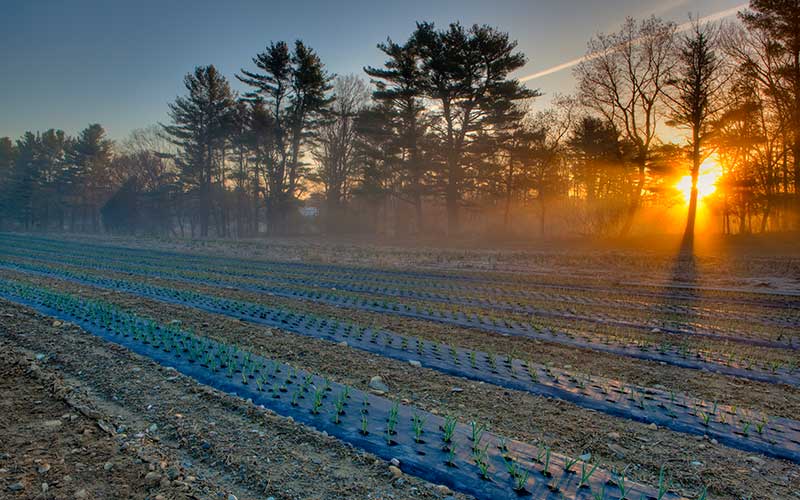
Small, local New England farms play a crucial role in a healthy, resilient food system. Photo: EcoPhotography
For most people, food appears in colorful stacks in grocery store aisles as if by magic, and we all buy the best options we can afford. We may not spend much time pondering where it all comes from or why healthy, affordable fruits and veggies aren’t accessible to everyone.
The “food justice” movement encourages people to rethink and reimagine the food system that we’ve all grown used to. Food justice means creating a food system in which everyone has access to nutritious food, regardless of income, background, or where they live. At first glance, this issue might not seem like a natural fit for an environmental nonprofit to tackle, but healthy food systems are better for the environment and build healthier communities that are better equipped to take on environmental challenges.
For the past ten years, CLF has been convening the Healthy Neighborhoods Study, a group of institutional partners like MIT and Metropolitan Area Planning Council, The program was developed with funding from the Robert Wood Johnson Foundation. Through the study, CLF partners with community members, known as “resident researchers,” and community-based organizations, to not only conduct research but leverage the results into projects strengthening each community. We recently put our Healthy Neighborhoods Study learnings into action through a pilot project focused on food justice in three of the communities.
Connecting People With “Healthy Incentives”
Most people are familiar with the Supplemental Nutrition Assistance Program, or SNAP, better known to some as food stamps. Massachusetts’ Healthy Incentives Program is the program’s lesser-known and enormously underrated cousin. All SNAP recipients in Massachusetts also receive up to $80 per month to spend at farmers’ markets, with no impact on their SNAP benefits.
For families that are on a tight food budget, that extra access to fresh, local produce can be a gamechanger, but the program is very underused. A program designed to increase access to fruits and veggies could improve food justice in our communities – but it accomplishes nothing if people aren’t using it. CLF’s Healthy Neighborhood Study put together a pilot project to change that.
The study’s chosen intervention was simple but highly effective. The team recruited Healthy Incentives Program users to act as ambassadors to spread the word and share their personal experience using the program. The ambassadors stationed themselves by lines of customers at farmers’ markets and shared information about the program. They offered handouts in multiple languages, since inclusivity is a key part of food justice. Their biggest challenge was convincing potential recipients that the benefits weren’t too good to be true.
Moving at the Speed of Trust
Marcia Picard, a Fall River resident researcher who helped coordinate the Healthy Incentives Program ambassador project, pointed out, “People are so mistrusting of the government or people from the state that they’re not going to believe [they] get food for free …. If you don’t trust the people who give you the message, you won’t trust the message.” A key to the project’s success was hiring people who have used the program themselves to conduct the outreach.
Trusting community-based, lived experience is key to both the Healthy Neighborhoods Study and food justice principles. The ability to personally attest to the effectiveness of the program to farmer’s market visitors made the ambassadors far more trustworthy and impactful. Sometimes they would even accompany potential Healthy Incentives recipients to the front of the line to talk them through the simple process of accessing their benefits. The ambassadors were careful not to make anyone self-conscious by singling them out, instead offering information to the whole line.
A Win-Win for Farmers, Families, and the Environment
Promoting the Healthy Incentives Program has obvious advantages for the families using it. “When you buy fresh fruits and veggies in the grocery store, it’s not the cheapest thing,” said David Underhill, another Fall River resident researcher and ambassador who helped lead this project. But lower-income residents “should have the opportunity to get fresh-grown produce. It’s essential to their health.” The dietary benefits of fresh fruits and vegetables are well-established.
But promoting food justice is also essential to the wellbeing of local farmers and the environment. Smaller farmers often struggle to compete with bigger factory farms, and farmers’ markets can be a lifeline. The more people make use of the Healthy Incentives Program, the more money flows into the pockets of smaller farm operations that rely on these outlets. “It was such an easy sell to the farmers,” said Picard. “There’s no downside to it at all.”
Locally produced food also tends to be better for the environment, another key component of food justice. Food doesn’t have to travel as far, producing less carbon pollution in the process.
The Future of CLF’s Healthy Incentives and Food Justice Work
While the current iteration of the pilot program is winding down, the resident researchers are enthusiastic about keeping the ball rolling. The Healthy Neighborhoods Study team shared this model with other food access organizations, and two of them have already received grant funding to run this program in more neighborhoods.
Picard anticipates the word continuing to spread about the Healthy Incentives Program. She shared that one recipient hugged the ambassador after learning about this program that no one had explained before. “Someone like that, who’s had a positive experience, we hope is apt to tell others,” said Picard. She’s already rehired the ambassadors to promote the Healthy Incentives Program at another health-oriented event that she helps lead.
Overhauling our food system to be more equitable, accessible, and environmentally friendly is a massive undertaking. Connecting lower-income residents with free, fresh produce is a significant step in the right direction. But there’s much more work to be done. Check out part two of this blog series on CLF’s farm and food work to learn about the concept of “food sovereignty,” and how the Healthy Neighborhoods Study is fighting to make it a reality.