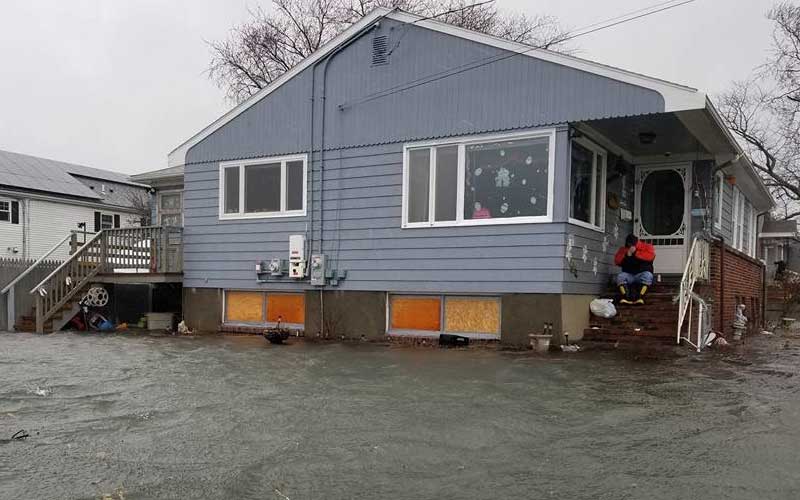
Everyone deserves to know the risks of the property they buy, including how vulnerable it is to extreme weather. Photo: CLF.
I’m lucky to be looking at houses right now, and there’s one question I ask at every open house without fail. “What’s the flooding history?”
I think we can all understand why it’s such a concern. I grew up in homes where a moderate rainstorm could flood our basement. I will never forget the image of my mother setting up massive fans, mopping up water, and freaking out about mold growth. Even in my rental unit right now, I’m anxious about water leaking in during heavy rainfall. And those of us who haven’t experienced flooding ourselves probably have friends, family, and neighbors who have.
I used to be able to find some information on flooding risk before seeing a house on sites like Zillow, which typically included an extreme weather risk assessment. But now, Zillow has removed this assessment – and real estate groups are pressuring other listing sites to do the same.
What does this mean for you and me? Let’s find out.
It’s A Bad Time to Hide Data – Extreme Weather is Getting Worse
In the last few years alone, homeowners across the country have been hit by unnatural disaster after disaster. From Montpelier, Vermont, where devastating flooding two years in a row rivaled the damage from 2013’s Tropical Storm Irene, to Los Angeles, California, where wildfires burned homes and businesses to the ground. Even Asheville, North Carolina, which many thought to be a safe haven from extreme weather, was hit with home-submerging flooding. The reality is, more and more homeowners are finding themselves at the mercy of fires, floods, tornadoes and hurricanes. We have never needed an assessment of extreme weather risk more than we do today.
And that need for data is even more important as the federal government rolls back common-sense protections and financial support for extreme weather damage. At the same time, home insurance companies are jacking up their rates for (or completely dumping) customers in extreme-weather-prone areas. Every home buyer deserves to know the chance that their property will be hit next.
How Can We Be Prepared if Listing Sites Hide Information?
According to Ella Nilsen at CNN, the California Regional Multiple Listing Service is the reason for Zillow’s change. This real estate organization operates one of the biggest private databases of home listings in the entire country. Zillow relies on the Service to fuel their online listings.
The Service says it’s worried about the accuracy of the risk data and how it affects home sales. (To no one’s surprise, people are less willing to buy homes in high climate risk areas.) Zillow says it removed the risk date to comply with the Service’s requirements. Unfortunately, the organization also contracts its database to Redfin, Realtor.com, and others – which are now facing similar pressures to remove extreme weather risk data.
There are some questions about the accuracy of the risk assessment. First Street, which is the company that provides listing sites with the data, told Nilsen its assessments are more accurate than FEMA. But its data isn’t public, so there’s no way to test rigor.
Regardless, risk assessments are just that – estimations and predictions, not promises. We use risk assessments to evaluate so many other things in our lives: investing our money, taking a new medicine your doctor prescribed, deciding which contractor to go with to fix our appliances. We need these predictions to make informed decisions on what we’re willing to deal with – and that includes extreme weather.
Just Because the Data is Gone, Doesn’t Mean the Risk is Gone
Hiding the data doesn’t hide reality. It just leaves homeowners unprepared. And, more insidiously, removing extreme weather risk is a sneaky way to shift responsibility away from the real estate industry and onto homeowners alone. Sales can bump up, and the real estate industry can stuff their wallets, but at what cost to all of us? For example, what if homeowners can’t get home insurance in places they didn’t know were high-risk (and this is already happening with the data available)? What about homeowners with tight finances and lower budgets investing their hard-earned dollars without the full picture – the same homeowners who probably are least able to afford losses, repairs, and evacuation?
It’s not like we haven’t seen similar moves from mega industries before. Fossil fuel companies popularized the idea of a personal carbon footprint so that the responsibility of cutting emissions lay with our choices – not their dirty products. Big plastic popularized the idea of recycling so they could continue profits-driven business-as-usual while blaming us for behavioral choices instead. Now, the real estate industry is burying the inconvenient truths that threaten their bottom line. This is a pattern for big business to get away scot-free while we suffer the consequences.
We Can’t Let Climate Change, and Corporate Accountability, Go Unchecked
These moves from the real estate industry, along with the federal government’s lack of support, are why states need to step up and protect families and businesses.
Aside from the need for more transparency about extreme weather risks, states need to tackle the root of the worsening problem: toxic carbon pollution that overheats the planet. Most of our states are on the right track with laws in the books demanding cuts to pollution – but many states aren’t implementing those laws. And worse, some are considering softening their demands.
States also need to stand up for and enact laws that support rebuilding after extreme weather. For example, Vermont’s Climate Superfund law (a first of its kind across the country) asks the biggest polluters to pay their fair share for cleaning up after extreme weather, which their products directly cause.
All of us deserve to know what we’re walking into when we’re committing to a home, ideally, for decades to come. Homeownership comes with a lot of surprises – but vulnerability to fires, floods, and other extreme weather shouldn’t be one of them. And when climate change is affecting our lives right now, whether we like it or not, we have the right to make an informed decision about the risks we take for ourselves and our loved ones.