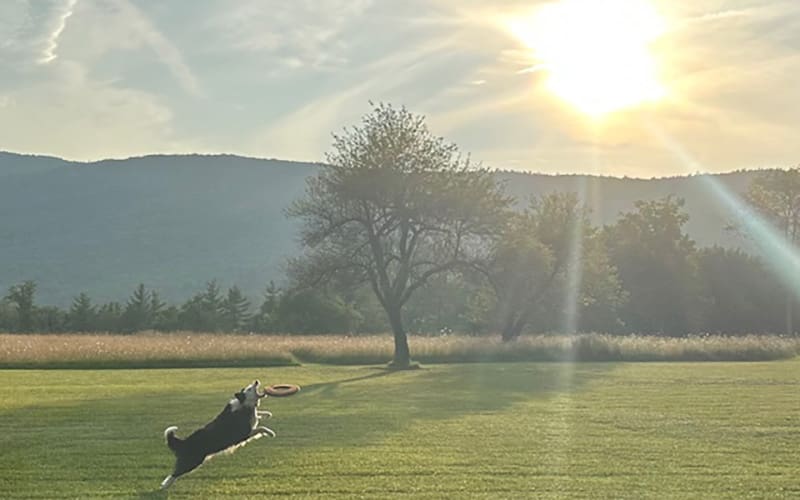
I love taking my dog for walks around my Berkshires home, but on hazy days, I worry about how the air pollution affects both of us. Photo: Cynthia Pansing
Summer in my home in the Berkshires, Massachusetts, conjures timeless vistas of crystal blue skies, fresh air, wooded landscapes, waterfalls, rolling farmlands, scenic small New England towns, kayaking on local lakes, and picnics at Tanglewood. Every day in the Berkshire hills where I live, I look forward to walking my dog and enjoying the sights, smells, and sounds of this beautiful area.
But over the past few years, this idyllic vision has changed. For those of us who live here, summer in the Berkshires now also conjures hazy, gray vistas, air heavy with toxic smoke from Canadian wildfires, overbearing heat and humidity, and health advisories to stay indoors. As in many other communities in New England and beyond, this is happening more often due to climate change.
During the past three summers, walking with my dog has become more difficult. Last summer was the hottest I have spent in the Berkshires in more than 10 years of living here. And the air quality has reached unhealthy and even unsafe levels for everyone, not just vulnerable groups.
The Berkshires and Wildfires: The New Normal?
Judging by the trend over the past few summers, this pattern will repeat itself in the coming years – and not just in the Berkshires. Whether in rural or urban areas or somewhere in between, no one will be immune in New England and elsewhere to high heat, wildfire smoke, and poor air quality. These conditions will have profound effects on our health and well-being.
Earlier this year, the American Lung Association State of the Air report gave Berkshire County a surprising “D” grade for high levels of the fine particle air pollution known as “PM 2.5.” In rural areas like the Berkshires, high rates of this form of air pollution are increasingly common. This is because of Canadian wildfire smoke, along with diesel engines and other oil-reliant sources.
Due to climate change, these wildfires are increasing in frequency and are becoming a permanent fixture of the summer air. Furthermore, the heat, humidity, and droughts associated with climate change exacerbate the air’s unhealthy and unsafe conditions.
Fine particle air pollution is unhealthy for sensitive individuals, including children, teenagers, older adults, those with asthma, pregnant women, and people who are active outdoors. But in high enough concentrations, this pollution can make the air unsafe for everyone.
Fine Particle Air Pollution Impacts the Whole Body
Over this past summer of 2025, nearly a week’s worth of Berkshire days exceeded the unhealthy air quality index levels. All residents were warned to remain indoors. Belonging to three of those sensitive groups, my daughter and I experienced the typical symptoms of unhealthy levels of fine particle pollution. These symptoms include watery, burning eyes, shortness of breath, wheezing, coughing, and sore throats.
But there are other reasons for concern about PM 2.5. While the air quality index is an important indicator of how unsafe the air is, this index does not tell the whole story. According to researchers, unhealthy levels of fine particle pollution occurring for even one day can have a negative impact on health.
When fine particle pollution encounters the human body, it triggers what is known as a “whole body response.” These tiny particles burrow their way deep into the lungs and bloodstream. Over time, this can lead to chronic health effects.
Climate Change Knows No Bounds
We may think of apparently pristine, wooded areas like the Berkshires as local lungs that help purify the air and absorb carbon pollution, but in this era of climate change, they cannot keep up with the task. They are already overloaded and are becoming more so.
Given how this is impacting air quality in the Berkshires, imagine what is happening in urban communities. Compared to rural areas, urban communities have heavier concentrations of pollutants, fewer cooling green spaces and trees, and islands of concentrated heat that can be difficult to escape.
This has a negative impact when it comes to fine particle air pollution. Due to climate change and our national addiction to oil, PM 2.5 is now present at high levels in both urban and rural areas.
In cities, Black and Brown communities are most exposed to poor outdoor air quality from car, bus, and truck exhaust. These communities, unfairly burdened for years with polluting infrastructure, experience even higher rates of significant and chronic health issues, like asthma, which are aggravated further by high heat and humidity. Whether you live in the shady woods of the Berkshires or the bustling streets of Boston, we all want safe, clean air that won’t make us sick.
Our Unraveling Safety Net Is Eroding Our Protections Against Air Pollution
While climate change- and oil industry-caused air pollution is occurring all over, there is a national trend that is making matters worse: the federal government is tearing apart our health and environmental safety net.
By defunding key agencies, rolling back regulations, and more, this administration is slashing almost every thread of the fabric of our safety net. It is opening the doors wide for oil, coal, chemical, and logging industries to operate without restraint or guardrails. These actions prevent us from monitoring and safeguarding everyone against harmful threats to public health and the environment, like fine particle air pollution.
There is so much that the federal government is doing everywhere, all at once. It can be a challenge to see the impact on our communities’ well-being and our planet’s survival, much less figure out what to do. Yet there is so much we can do and are doing.
What CLF Is Doing: Fighting for Clean Air for All New Englanders
With the federal government’s actions, it is increasingly up to us – our states, local communities, and nonprofits – to step in and step up. And we are.
To tackle air pollution, CLF has crafted policies to reduce tailpipe emissions and uphold anti-idling laws, especially in vulnerable communities. We have sued utilities to hold them accountable for tree-killing methane leaks, while promoting policies to support community green spaces and tree planting. At the same time, we’ve worked to strengthen community health and well-being to support a climate-resilient future. And we are strengthening the voices of citizens to reduce vehicle pollution through citizen lawsuits.
Most recently, we are advocating for the state to expand air quality monitoring stations throughout the state, from vulnerable urban communities to the rural Berkshires.
What You Can Do
The chaotic damage carried out by the federal government is in no one’s interest except for its own and its industry allies – and it will not endure. As we undergo this tectonic shift in the US, it is critical to take action where we can and sustain hope.
While it can be difficult to see a path forward through the chaos, there is much you can do, including:
- Become a member of/support organizations on the frontlines, like CLF.
- Support and engage in local, state, and regional efforts to protect our public health and environment.
- Support the transition to a clean energy future.
- Speak out to your legislators and local government officials.
- Help amplify the voices of others who are often not heard.
When I walk my dog these days, I hold out hope that there is still something that we each can do, individually and collectively, to turn this situation around.
I think of the words of author and historian Rebecca Solnit: “Hope calls for action; action is impossible without hope.”
Let our hopes and actions take flight in these hugely challenging times.