New England's offshore wind projects are key to reaching our climate goals.
Offshore wind farms are a sustainable method for generating clean energy on a large scale. These projects harness the immense power of offshore winds, often stronger and more consistent than on land, to produce electricity. This makes offshore wind a critical part of the effort to combat climate change, which results from carbon pollution overheating our planet.
The development and deployment of offshore wind technology contributes to diversifying energy sources. When we use many different sources to produce energy, we become less dependent on just one energy source like fossil fuels. Additionally, when we use clean energy like wind power, we reduce pollution and slow down climate change. Finally, offshore wind technology helps promote economic growth through the creation of new industries and employment opportunities in manufacturing, installation, maintenance, and related sectors.
By tapping into the vast and renewable energy source of offshore winds, we can dramatically reduce our reliance on fossil fuels, cut carbon pollution, and diminish air and water pollution. That paves the way for a cleaner and more sustainable energy future for generations to come.
Q: What is an offshore wind farm?
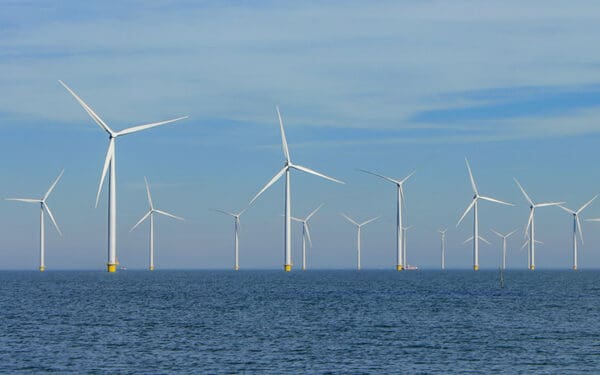
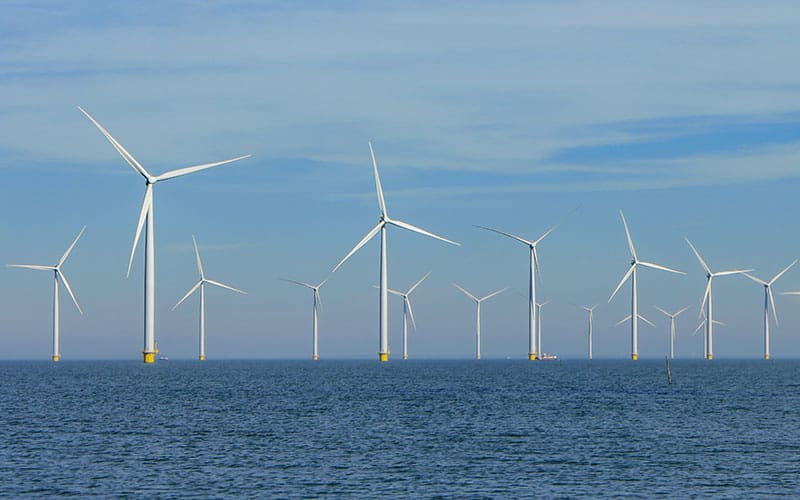
A: An offshore wind farm consists of a group of wind turbines located in a large body of water (like an ocean or even a large lake) that generates electricity by harnessing the energy of the wind.
As the wind turns the turbine blades, energy is converted into electricity through a generator housed within each turbine. The electricity is then gathered through a network of underwater cables and transmitted to onshore substations for distribution to the power grid. From there, that electricity is transmitted to our homes and businesses.
Not only are wind turbines clean energy, they are incredibly efficient. The first commercial-scale offshore wind farm in U.S. federal waters, New York’s South Fork Wind project, determined that just one rotation of a turbine blade generates enough electricity to power an average home for 24 hours.
Q: What is the difference between onshore and offshore wind projects?
A: Offshore wind projects are typically more efficient than onshore because wind speeds are generally stronger and steadier at sea than on land. The consistent and powerful winds offshore minimize fluctuations in electricity production, leading to a more reliable energy supply.
Additionally, the open expanse of the ocean allows for the development of bigger wind projects with bigger turbines, which increases how much wind power the projects can capture.
While offshore wind projects have their advantages, there are many benefits to onshore wind farms as well. Onshore wind projects are typically less expensive to build and maintain because they’re easier to access. Because they present fewer logistical challenges, developers can typically build onshore wind farms more quickly.
Q: Can offshore wind farms be developed to minimize their impacts to the environment?
A: Yes! Offshore wind turbines produce clean, renewable energy and reduce dependence on the fossil fuels causing our planet to overheat. CLF has advocated for offshore wind developers to follow responsible development practices to avoid or minimize potential harm to the delicate balance of marine life and their complex ecosystems. Here’s how we can achieve that:
- Careful site selection which includes identifying areas with consistently high wind speeds, avoiding areas that are key habitats for marine life, and choosing areas that do not interfere with shipping lanes and historic fishing grounds.
- Use of advanced technologies such as bubble curtains that can muffle underwater construction noises and minimize the impact on marine life.
- Detecting whales that come near offshore wind project sites with environmental monitoring systems and trained spotters. This way, the developers can pause potentially hazardous construction when whales are near and help boats to avoid collisions with whales.
- Thorough environmental impact assessments, including marine mammal and fish population surveys and seabed habitat mapping, bird and bat migration studies, and evaluations of the collective effect of multiple offshore projects in a region.
- Vessel speed and navigation requirements, such as restricting boats and ships to traveling at 10 knots or less to minimize the chances and dangers of a collision with whales, and limiting construction in times and places where at-risk species are likely to be.
Q: How long do offshore wind turbines last?
A: Offshore wind turbines generally have a lifespan of 20 to 25 years, assuming consistent and scheduled maintenance is performed. However, some estimates suggest that offshore wind farms could potentially remain operational for 30 to 40 years.
According to the Department of Energy, upwards of 90% of wind turbines’ mass can be recycled. Scientists are actively working on figuring out how to recycle or reuse the remaining 10%, including using more sustainable materials. When a project is decommissioned, the owners must reuse, recycle or responsibly dispose of all materials.
Various factors impact the actual lifespan of a wind turbine, including the marine environment in which it’s located, the quality of manufacturing and installation, the frequency and thoroughness of maintenance, and unforeseen events like severe weather or component failures. Regular inspections and proactive maintenance are crucial for maximizing the lifespan and ensuring the efficient operation of offshore wind turbines over time.
Q: Where are offshore wind farms most common?
A: Offshore wind farms are common in Europe, particularly in the North Sea and Baltic Sea regions. Countries like the United Kingdom, Germany, Denmark, and the Netherlands have made substantial investments in offshore wind energy. In Asia, China excels in offshore wind development, with significant projects along its coast. Currently, they are global leaders in offshore wind installations.
The United States has more recently entered into the offshore wind market, with initial projects primarily located along the Atlantic coast. The current federal administration is trying to shut the offshore wind farms down, often on flimsy pretexts. CLF is among the groups advocating for the government to allow these vital efforts to move forward. As technology advances and costs decrease, offshore wind farm development is expected to expand to other regions around the world.
Q: What is the future of offshore wind energy?
A: Despite current political opposition, the future of offshore wind energy holds tremendous potential. Technological advancements and increasing global commitments to renewable energy sources could help this technology take off.
Advancements in floating turbine technology is one area making progress. This particular technology resolves the limitations of traditional fixed-bottom turbines, which are restricted to shallower waters. Floating platforms allow wind farms to be installed farther offshore where there are stronger and more consistent winds.
Additionally, investments in renewable energy are increasing across the world as governments and private entities recognize the urgency of addressing climate change.
Support from states up and down the United States’ coasts, in addition to financial incentives and ambitious renewable energy targets, has motivated significant investments in offshore wind projects. While the current federal opposition to offshore wind poses a steep challenge, the technology remains a crucial component of our clean energy future.
Q: How can I support expansion of offshore wind farms?
A: Given the urgency with which we must address climate change, forging ahead with renewable energy sources like offshore wind projects is more critical than ever. You can get involved in supporting these projects in several ways:
- Let your state and federal representatives know you want them to support the offshore wind policies that enable this technology to forge ahead.
- Educate friends and family or share the facts on social media.
- Support CLF in our fight against climate change.