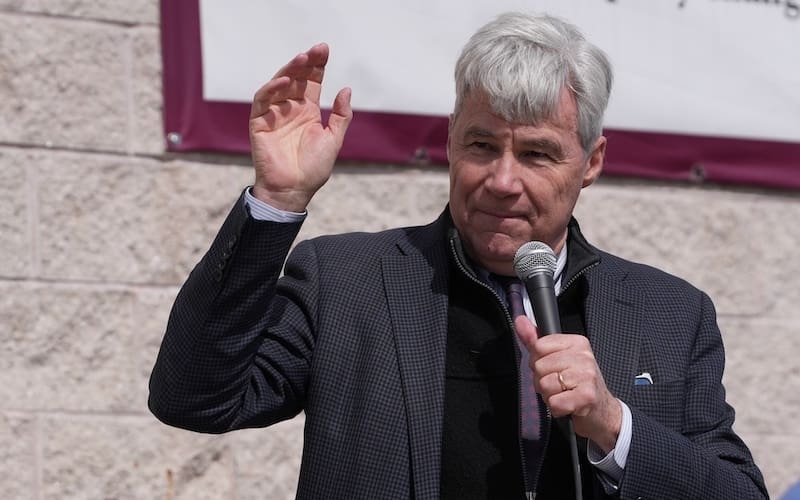
Senator Sheldon Whitehouse has identified a strategy to help shift political intraction toward sound environmental policy. Photo: Shutterstock.
On the surface, this moment appears bleak for the environment. The Trump administration systematically rolls back key environmental protections, while hindering clean energy development and eliminating incentives for essential technologies like electric vehicles and solar power. Meanwhile, Trump leans heavily into climate-warming fossil fuels, in a year on track to be one of the hottest on record.
While the challenge is nothing less than daunting, Rhode Island Senator Sheldon Whitehouse sees a path forward. Whitehouse, a ranking member of the Senate Environment and Public Works Committee and co-chair of the U.S. Senate Climate Change Task Force, sees opportunity even for bipartisan action. It’s up to those of us who care about the planet to forcefully convey the stakes.
Below, we’ve excerpted some of his thoughts on what he calls “the villain, a cure, and a shift.” Remarks have been edited for length and clarity.
We Need to “Go Right at Them”
There’s an epic villain in the climate story, and unfortunately, the previous administration was never willing to use its bully pulpit to say so. But no doubt, the climate denial fraud operation and its contiguous dark money influence operation are classic villains. And we should say so.
If we make the denial fraud operation and the corrupting dark money operation huge issues, we’ll have immense public support. Public support for getting rid of dark money is up in the 80s. It’s a huge, powerful political win for us to engage hard on the corruption that fossil fuel dark money has brought to this issue.
We should call out the climate denial fraud operation as climate denial fraud. It is fraud. Say so. Go right at it on that basis.
Every story is better with a villain in it. These are alive-and-well, central-casting-quality, epic villains.
Talk about it as a single, evil operation. The climate denial fraud wouldn’t be effective without the dark money political influence; and the dark money influence backstops people who spread the climate denial fraud – the two are intertwined. This is a battle worth having, and we’ve got the public at our backs.
So, point one: There’s a villain. Say it. Use it.
There is a Path to Climate Safety
Point two: There’s a cure. Our pathway to climate safety has gotten very steep and very narrow because of fossil fuel opposition and obstruction. But there is still a pathway to climate safety, and it involves putting a price on carbon.
You can’t reduce carbon emissions when you can pollute for free. The fossil fuel industry’s pollute-for-free business model kills any remaining hope of a pathway to climate safety. So, where do you look for a way to put a price on carbon? Well, the European Union has already passed into law its CBAM, or Carbon Border Adjustment Mechanism.
It is law. They’re going to put a price on carbon emissions in tariffs, when polluting companies and countries try to import products into the European Union. They’ve defended it fairly well against Trump’s pressures. Actually, the theory that foreign companies’ pollution advantages hurt domestic manufacturers and deserve tariffs is totally bought into by the Trump trade folks. It’s just that everybody around Trump gets weird when it’s fossil fuels. But in theory at least, they’re with us.
Carbon Tariffs Are a Critical Tool
The CBAM is not just an EU thing. The UK has coordinated its internal carbon pricing with the EU so that they don’t have to pay tariffs, in fact they’re planning their own tariff. The Australians are doing the same thing, another big economy. Canada’s new Prime Minister used to run the Bank of England and is an expert on what climate change is going to do to the world’s financial systems. So, I would not be surprised if Canada were to join the UK and Australia in joining CBAM. Mexico’s President, Claudia Sheinbaum, was a scientist with the Intergovernmental Panel on Climate Change. She totally understands climate change dangers.
More and more trading partners are moving towards joining the CBAM, which makes it a powerful global price on carbon emissions; a means to an end of the fossil fuel industry’s lethal free-to-pollute business model. We have to protect and defend at all costs the CBAM and the countries that are moving towards it.
It’s an interesting enough idea that there’s bipartisan support for a United States carbon tariff in the Senate. I’m the author of the Democratic bill; Bill Cassidy of Louisiana is the author of the Republican bill, supported by Lindsey Graham. Our bills don’t match yet, but we’re working on it. The fact that there are bipartisan bills really, really helps.
So that’s the villain, and that’s the cure.
The Shift Changing Climate Politics
What’s the shift?
We went through the era of climate science, when the scientists basically told us ‘here’s what the hell’s going to happen;’ to the era of climate politics, where the fossil fuel industry, with dark money and a pack of lies, shut down a political response. Now, we’re in the era of climate consequences.
The stuff that the scientists told us was going to happen is now starting to happen. It’s first turning up in homeowner’s insurance. Why? Because insurers have to look forward into the future. They’ve got to predict. There are areas of the country where homeowner’s insurance is no longer predictable, so the risk is no longer insurable. It started with coastal risk, from sea level rise and worse storms and rain and flooding. But in recent years, the explosion in wildfires has made wildfire risk the evil sibling comparable to coastal risk.
A Cascading Series of Problems Already Playing Out
The insurance problem doesn’t end there. It cascades. How does that work? It starts when you can’t get insurance on a piece of property because an insurance company can’t price or accept the risk of wildfire or flood on that particular piece of property. When that happens, that piece of property can’t get a mortgage any longer. Well, if you’re a billionaire trading mansions, that doesn’t matter. But if you’re the plumber living in a development outside of Orlando who bought his house with a mortgage and needs to sell it to somebody who needs to get a mortgage, you just took a terrible blow to what is probably, for most families, the biggest asset you own: your home.
The insurance problem cascades into a mortgage problem. The mortgage problem cascades into a property values problem. And it’s so bad, that not long ago, the former chief economist for Freddie Mac, the mortgage giant, said the insurance cascade is going to cause what he called a coastal property values crash that will create a 2008-style full-on economic meltdown.
A Real Cure
If your homeowner’s insurance goes up, that could be $2500. It’s a huge expense for a family, and it’s already starting to happen. That economic hit is going to create an enormous political shift, because it’s not about polar bears and green jobs anymore. Now, it’s about climate risk coming for your economic safety, your ability to get insurance or a mortgage on your home, your ability for your home to have value when it needs to be sold, and, of course, your harm when all that cascades out into the general economy.
So, I think that’s the way we have to look at climate change now. We’ve got to take advantage of having real villains. We’ve got to have confidence that there is a real remaining cure. And we’ve got to understand that this is about to become a flaming pocketbook issue for Americans who right now don’t see climate change as something that immediately affects them. If the 2008 prediction is true, this affects everyone.