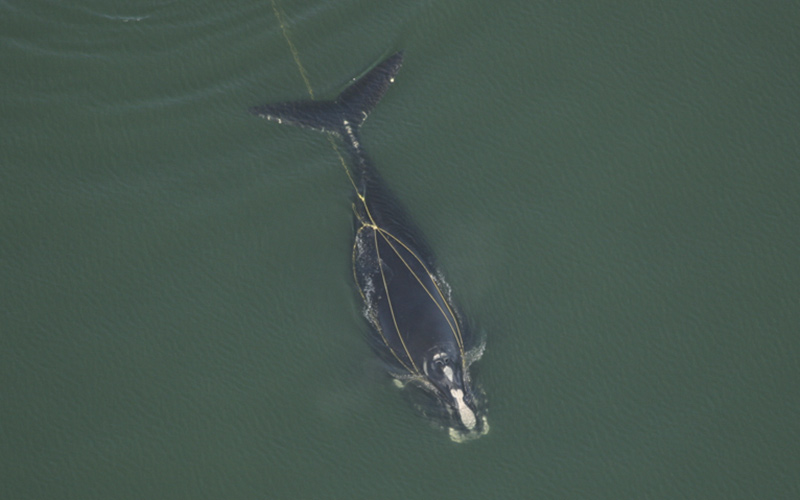
Entanglements in fishing gear can make North Atlantic right whales weaker, less likely to have babies, and even fatally injure them. Photo: Florida Fish and Wildlife Conservation Commission, NOAA Research Permit #594-1759
Five years ago, I was afraid I’d see North Atlantic right whales go extinct in my lifetime. After a hard-fought agreement to reduce the number of vertical lines used in lobster fishing, several lawsuits, new federal rules to reduce entanglement risk, and congressional funding, the future looks a little brighter. These lines that connect buoys on the surface to traps on the sea floor are the leading cause of right whale deaths, which can become accidentally entangled in them.
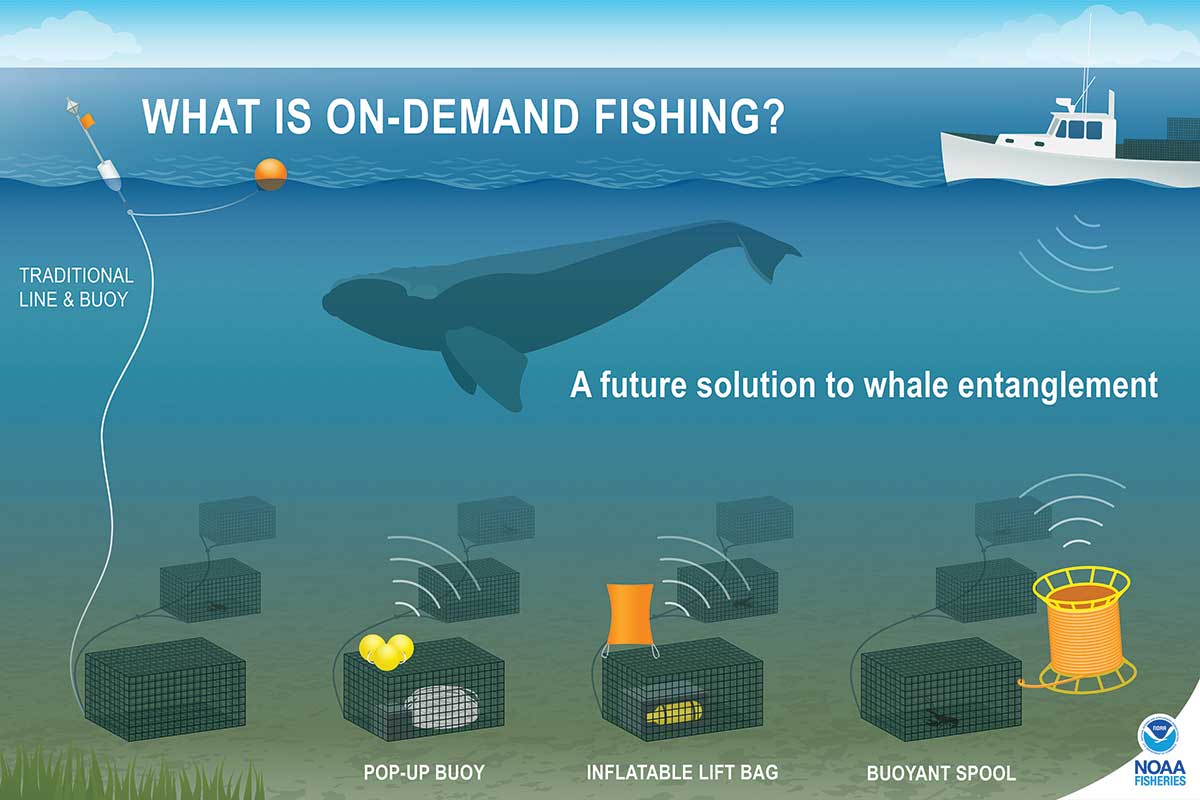
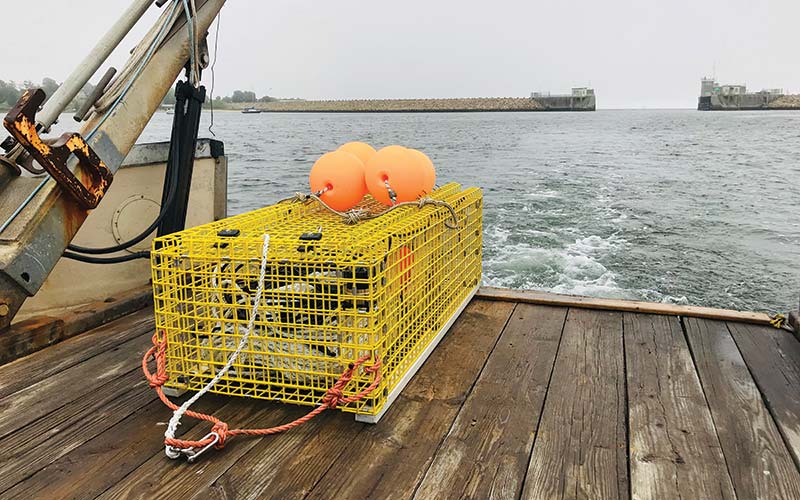
Luckily, there is a promising path forward: “on-demand” fishing gear, sometimes called ropeless or pop-up fishing gear, has been successfully deployed by forward-thinking fishermen in trials over the last five years. Instead of using stationary vertical lines, these systems use acoustic technologies to bring a trap with a rope stowed inside to the surface. These technologies have successfully brought scientific gear off the seafloor for 50 years, and their use in lobster fishing has been discussed for decades.
There have been challenges. While conservationists initially worried that the gear might not work effectively, fishermen have successfully retrieved their gear more than 90% of the time in trials throughout the Northeast. And while fishermen worried that if this new gear worked well, it might be required everywhere, National Oceanic Atmospheric Administration Fisheries has confirmed they won’t require its use in the lobster fishery. Rather, the government will allow fishermen to use on-demand systems to access areas where fishing with vertical lines is otherwise restricted when right whales are present.
On-Demand Fishing Provides Right Whales with a Fighting Chance at Recovery
Critically endangered North Atlantic right whales face extinction, in large part because of entanglements in fishing gear. Fishermen don’t intentionally entangle whales – they lose valuable fishing gear and their catch when that happens, and no one wants to hurt a whale. But the reality is that U.S. and Canadian commercial fisheries entangle whales far too often. More than 85% of right whales bear scars from having been entangled at least once.
If a whale doesn’t free itself or die immediately, it may suffer for months, entangled in and dragging heavy fishing gear as it migrates, socializes, and searches for food. Most entanglements cannot be tied to a fishery or even country of origin because the line is either gone by the time the whale is found or inadequately marked. But in 2024, a young three-year-old female right whale died after spending half of her short life with a rope from the Maine lobster fishery wrapped around her tail. Because of chronic entanglements, the species is getting physically smaller, would-be moms are weaker, and fewer calves are born.
How On-Demand Fishing Gear Works
A range of ropeless gear technologies promises solid alternatives to vertical lines in the water.
Here’s how on-demand fishing gear works in fishing industries in New England that use traps or a type of weighted nets called “gillnets”:
- Traps (or weighted nets in fisheries that use gillnets) are dropped on the ocean floor.
- When it’s time to retrieve the traps or nets, fishing crews send an acoustic signal from a transducer (a type of sensor) on their boat to a release mechanism attached to the first trap or last trap (or both) in a string of traps. These transducers can be permanently mounted in the hull of the vessel and save fishermen time by sending the signal before they even arrive at their gear.
- As shown below, depending on the type of system, either a pop-up buoy, an inflatable lift bag, or buoyant spool of rope arrives at the surface.
- From here, the crew can haul traps onto their boats using traditional fishing practices.
On-Demand Fishing Provides Fishermen with Tools to Fish in Restricted Areas
To protect right whales, 62,000 miles of ocean water in the Northeast are seasonally closed to traditional fishing with vertical lines. This is a great solution for whales, but it isn’t such a great solution for fishermen kept from fishing in their historical fishing grounds. So, in 2020, the Northeast Fisheries Service (part of National Oceanic and Atmospheric Administration Fisheries) started a Gear Lending Library with help and donations from environmental and academic organizations, including CLF.
The Library’s goal is to provide fishermen with the technical experience they need to resume fishing in restricted areas. In 2023, the state of Maine started its own Innovative Gear Library with the goal of gathering data from fishermen “to evaluate which systems can cost-effectively minimize risk, work consistently in the variety of conditions fishermen face, and support enforcement needs for gear location and retrieval.” On the west coast, the National Marine Sanctuary runs a gear lending library, and some fishermen are purchasing their own gear to access areas restricted to prevent humpback whale entanglements.
In the Northeast, the Gear Lending Library offers more than 10 different on-demand systems and more than 750 different units. Once a qualifying fisherman completes training on the system they intend to borrow, they can use the gear and fish in the restricted areas. In return, they share valuable data on the gear’s operation and any problems encountered. The library also welcomes suggestions for improving the gear. Fishermen’s feedback has been invaluable to the progress made to date.
In a video on ropeless gear created by NOAA (see below), one fisherman, Marc Palombo, shares how he dedicated countless hours to testing and providing feedback on this technology. Palombo, a proud third-generation lobsterman, has fished in New England waters for over 40 years. He says:
It’s exciting to lead the charge on something that could change the face of lobster fishing and to be that person giving the input … Somewhere down the line, it could be that I’m going to be having to fish in a closed area with ropeless gear. And I feel totally confident that if that was the case, I’m good. We are trying to save a species, and how we fished before is not the way we’re going to fish in the future.
Progress to Date
Under current regulations, adopting this newer, safer gear poses an immediate challenge to fishermen. NOAA requires a special permit to use on-demand gear, which can be time-consuming to obtain. This permit exempts fishermen from the regulations that require surface marking, like a buoy or a high-flyer when fishing with fixed gear on the bottom.
Surface markings enable fishermen to both mark their fishing location and use the vertical line attached to the nearest trap to retrieve their catch. Marking is also critical to prevent other fishermen from setting their gear on top of it or running over it. And finally, it is essential for law enforcement to know when and where fishing gear is set.
But with new technologies, on-demand gear can be “marked” digitally for other fishermen and enforcement, making the special permit unnecessary. That’s why NOAA and regional fishery councils have initiated a regulatory action that will allow on-demand fishing without a special permit. We support this important step to making ropeless fishing available to far more fishermen.
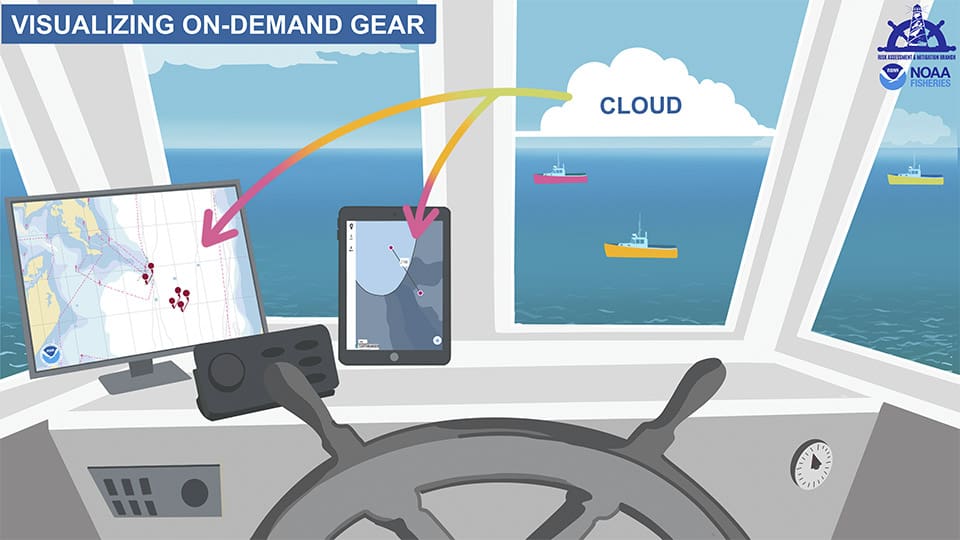
Since 2020, the Science Center’s gear trial has expanded from just three boats to more than 70 vessels, operating in four different fisheries and five states. Participants have collected data from more than 16,000 trap retrievals, and the rate of successful retrievals has gone from approximately 65% in 2020 (when COVID-19 presented training challenges) to 93% in 2025.
Fishermen who have tested or used ropeless gear report that the technology works. Depending on the fishery and the fishing conditions, one system may perform better than another for an individual or a fishery. The Dungeness crab fishers in California had a successful voluntary trial run in 2024, and rock lobstermen in Australia already use pop-up buoys to avoid illegal fishing. But, as with any new technology, there are a few more challenges before New England fishermen can use on-demand gear in the regular course of fishing.
Is On-Demand Ready for Prime Time?
The cost of on-demand systems remains a consideration. Currently, costs vary widely based on the sophistication of the system and its method of gear marking, but they are all expensive. Costs should decrease as the gear is refined, the volume of orders increases, and manufacturers begin to compete. Congress specifically set aside money for NOAA Fisheries to advance innovative fishing gear in the lobster fishery, which we expect will cover some of these costs. But none of that has happened yet.
There’s still some room to improve gear design. For example, engineers are working to resolve mechanical problems such as line snarls, which account for most of the failed attempts to retrieve on-demand gear. Engineers are also working to include strobe lights or radar detection methods to decrease the time it takes to locate gear at night or in challenging fishing conditions such as strong currents and bad weather.
Finally, while the technology for marking and transmitting data in real time has dramatically improved, we do not yet have cellular or satellite connectivity on all fishing boats that fish in close proximity to one another. To make this transition successful, partnerships among non-profits, the federal government, and industry will be essential to prevent placing the burden exclusively on fishermen.
By working alongside manufacturers and engineers, fishermen have already significantly improved gear design. With even more funding and support, a future where entangling ropes don’t unnecessarily endanger whales is in reach.
What You Can Do to Promote On-Demand Gear and Protect Right Whales
- Urge your congressional representatives to support funding for on-demand fishing during the annual appropriations process.
- Ask your local seafood restaurant if they carry lobster caught using on-demand gear. If they don’t, ask whether they plan to do so in the future.
- Support CLF as we actively promote innovative technologies that save whales and provide fishermen with the tools they need to keep fishing. With your help, we can work to ensure lobster fishing and whales can co-exist.